Showing posts with label brand loyalty. Show all posts

Monday, March 19, 2012

The Cost of Customer Service

Another topic, closely related to the bit I found about the cost/damage of failure to keep delivery/appointment promises, is the cost to the customer of remaining on hold waiting for service via telephone, as mentioned in this excerpt from Michael Hoffman's book on customer service:
I started writing this book while on hold with my cell phone company, listening to horrific canned music and hearing this recording every 90 seconds: “Your call is very important to us."

The CSR on this call was kind enough to remind me, “Sir, we have over 60 million customers to take care of” ... it occurred to me: “What if all 60 million customers were experiencing the same on-hold frustration?”
His accounting seems very hinky, even at a glance, so I'll not validate (by repeating) his estimation of the total value, and would caution anyone interested in quantifying the problem to do a bit more research. Even if you're more modest/realistic about the amount of time spent on hold and the per-minute value of a person's time, the number gets quite large when you multiply by 60 million.

What's more important from a brand perspective is how this disregard further contributes to the frustration of customers who feel their time isn't valued by brands that wish to earn their loyalty - the impact of which is far more damaging than the accounting suggests.
Saturday, March 17, 2012

The Wait-Time Misery Index

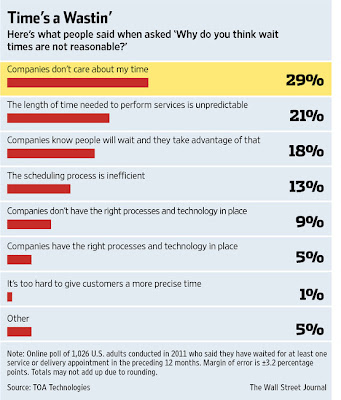
Here's an information graphic from a Wall Street Journal article about the problem of wait-time:


The article itself is a bit of a mess, choppy and superficial, but it speaks to a rather serious problem with home delivery and on-site services. Firms offer customers a broad window (sometime between 9 am and 3 pm on Tuesday) and then fail to keep that appointment.

There are snippets of information about it being more than a minor inconvenience - a survey is mentioned that more than half of adults use vacation time and more than a quarter have lost wages in order to wait. The implication is that the financial cost of waiting can be measured.

However, the quantifiable factors are far less damaging than the qualitative ones. Consider the responsess in the information graphic above: companies "don't care about" or "take advantage of" their customers or thye lack the competence to predict the activities of their own people or suppliers.

In all, this is a factor that merits far more consideration that it is evidently getting.